
The bag, not the stick
There’s a lot that’s been going on with the film (and LIFE) but I wanted to share something about my writing process today.
I don’t write traditional screenplays. All of my short films and my first feature were scripted, but I learned of some other techniques that really appealed to me. I tried them on my second feature and knew they were right for me.
I start with a blank document or journal and I’ll write anything; ideas for characters, places, situations, images, sounds, etc. When some of things begin to coalesce as a scene, I’ll write it on a 3 × 5 card. When the cards start piling up, I do this:
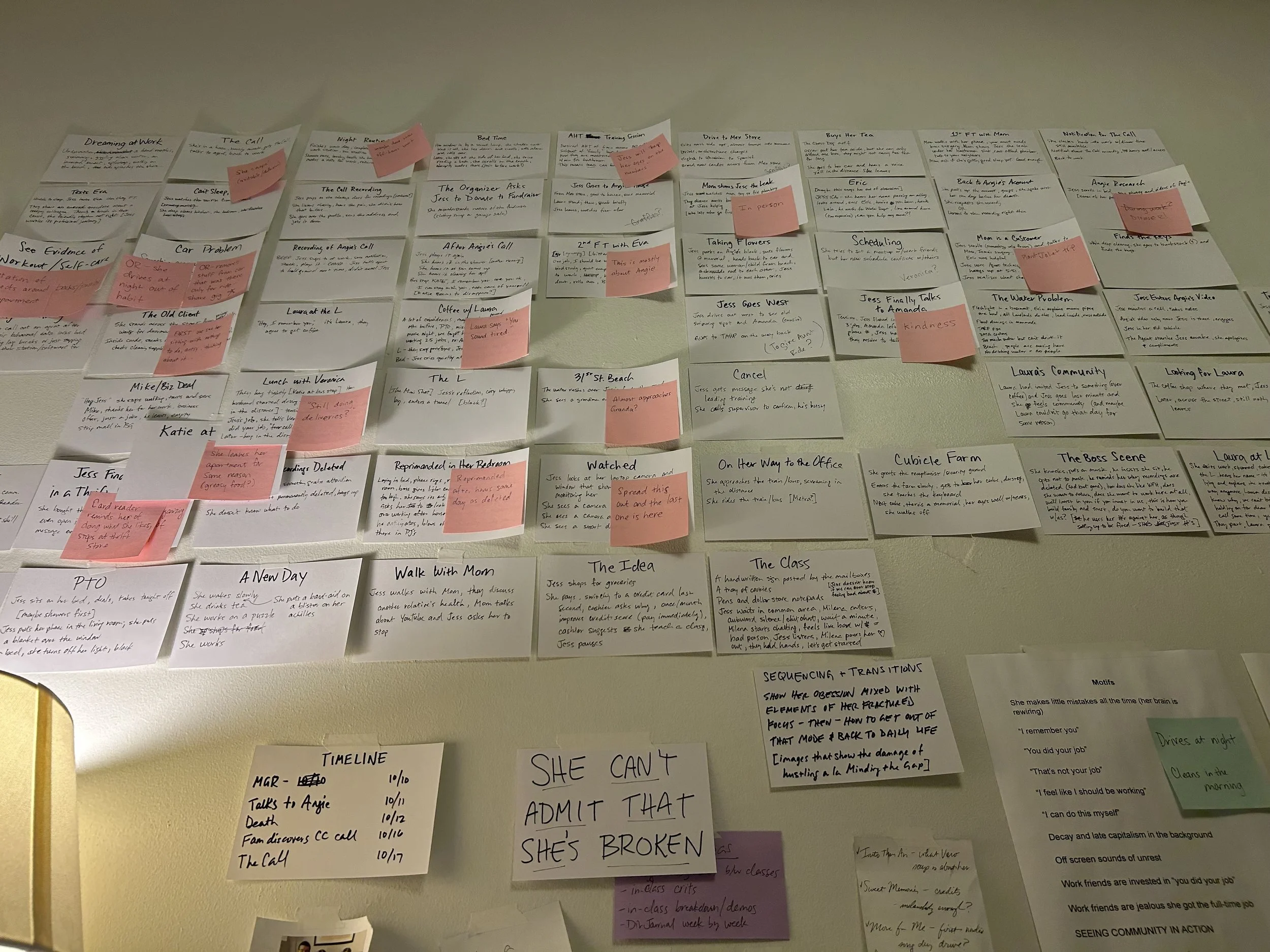
I sequence them on my wall. I’ll rearrange them, add new ones, remove others. You can see each card has a title with some description. And the cards at the bottom are notes to myself for the next step.
Once I’m happy with the order of the scenes, I turn it into a treatment with each scene as its own paragraph. Some of the scenes will have scripted dialog, but most will just have prompts. I take this treatment to my lead actor and go through it scene for scene and, in a way, they become my co-writer. We’ll change dialog or choices or actions in a way that suits the lead actor and their idea of the character they’re playing. Then the treatment gets rewritten and that’s what we take into production.
For the scenes without dialog, we improvise them on set. I’ll share the scene’s prompt or premise with the actors, and we improvise a scene moment for moment.
Not having a traditional screenplay can make planning for the shoot a bit messy, but I work with lovely and patient people who find ways to make it work. I owe them everything.
[By the way, the title of this post is a reference to Ursula Le Guin’s The Carrier Bag Theory of Fiction, which I highly recommend it for anyone who writes in any form.]